
LCHF and Keto 101 – A Beginners Guide to Low Carb Eating, Part – 2
In Part – 1 of this two part series, we looked at the wrong food guidelines, the anatomy of why we get fat and the basics of LCHF diet. In Part – 2 of this series, let us have a detailed look at Keto diet.
What is a Keto Diet?
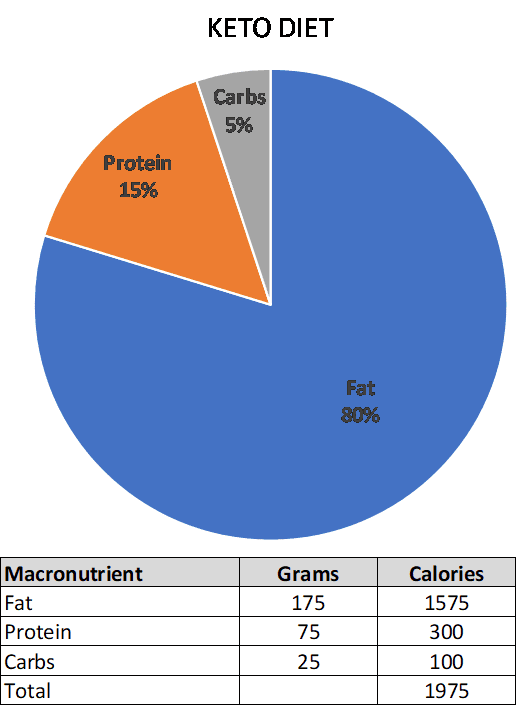
Keto is also an LCHF diet, but much stricter in carb intake – less than 20 grams of net carbs per day. Below chart shows the macronutrient composition in a Keto diet.
When we consume less than 20 grams of net carbs a day, our body goes into a metabolic state called Ketosis. In this state, the liver produces ketone bodies from fat cells and these ketone bodies are used as an alternate fuel in the brain, heart and skeletal muscles. However, liver itself cannot use ketones for energy and it produces glucose from fat and protein by a process called gluconeogenesis.
In the absence of glucose, as ketone bodies are the alternate fuel and as ketone bodies are produced only from fat, body essentially turns into a fat burning machine.
Advantages of Keto:
Below are some advantages of Keto.
- As body uses fat as its primary source of fuel, ketogenic diet is very useful in weight loss.
- Due to the very low carb intake, insulin levels stay very low. This helps in reversing insulin resistance which in turn can reverse type-2 diabetics.
- Ketogenic diet is also used therapeutically in managing diseases like Alzheimer’s, epilepsy and in cancer.
Disadvantages of Keto:
Below are some of the disadvantages of Keto.
- In the initial months of starting the keto diet, hair loss is very common. This can be controlled by taking biotin supplements.
- In ketosis, there is no in between state. The body is either in ketosis or not. Usually it takes anywhere from 4 days (for a fat adapted person) to even a couple of weeks (for a person who is not fat adapted) to put the body into ketosis. But body comes out of ketosis with just one cheat meal loaded with carbs. After this, it again takes the same 4 days to 2 weeks to get into ketosis. Because of this, cheat meals must be completely avoided in Keto, whereas LCHF diet (where Ketosis is not targeted) is much more forgiving when it comes to cheat meals.
- During high intensity workouts, muscles need glycogen (stored in muscles and liver) as source of quick energy. But as there is no stored glycogen in ketosis, performance suffers in high intensity workouts.
Formulating the Keto diet
There are two ways to follow Keto – the strict Keto and lazy keto.
Strict Keto:
In strict keto, the diet is formulated carefully for each individual and is accurately tracked by using apps like MyFitnessPal. Let us go through the steps with an example calculation.
- Decide the daily calorie target. This greatly varies based on gender, age and activity level. There are many calculators available online to estimate an individual’s daily calorie targets. For the sake of this calculation, let us assume 2000 calories.
- Decide the amount of net carbs. Net carbs are total carbs minus fiber. Usually, in Keto, net carbs are limited to 20 grams. Some go for 30 grams. For this calculation, let us consider 20 grams of net carbs.
- Decide the amount of protein. For individuals without any physical activity, this can be around 0.5 grams per kilo of lean muscle mass. For individuals who are physically active, it can vary between 0.75 grams to 1.5 grams of grams per kilo of lean muscle mass depending on the activity level. For example, if an individual weighs 100 kilos and has a fat % of 30%, he is considered to have 70% lean muscle mass which is 70 kilos. So, for the physically inactive, protein should be set to 35 grams (70 kilos x 0.5g). For the physically active, protein must be between 52 grams (70 kilos * 0.75g) to 105 (70 kilos * 1.5g) grams. For body builders this requirement would be even more. For this calculation, let us consider 1 gram per kilo, which is equal to 70 grams of protein.
- Calculate total calories from carbs and protein. Carbs and Protein have 4 calories per gram. So, for 20 grams of carb and 70 grams of protein, total calories = (20×4) + (70×4) = 360 calories.
- The rest of the calories must come from fat. Subtracting 360 calories from 2000 calories, we get 1640 calories. 1 gram of fat is equal to 9 calories. So, amount of fat required = 1640/9 = 182 grams.
- Once the macronutrient requirement is decided, the meals must be planned to meet this goal and tracked using apps like MyFitnessPal, Keto Diet Tracker etc.
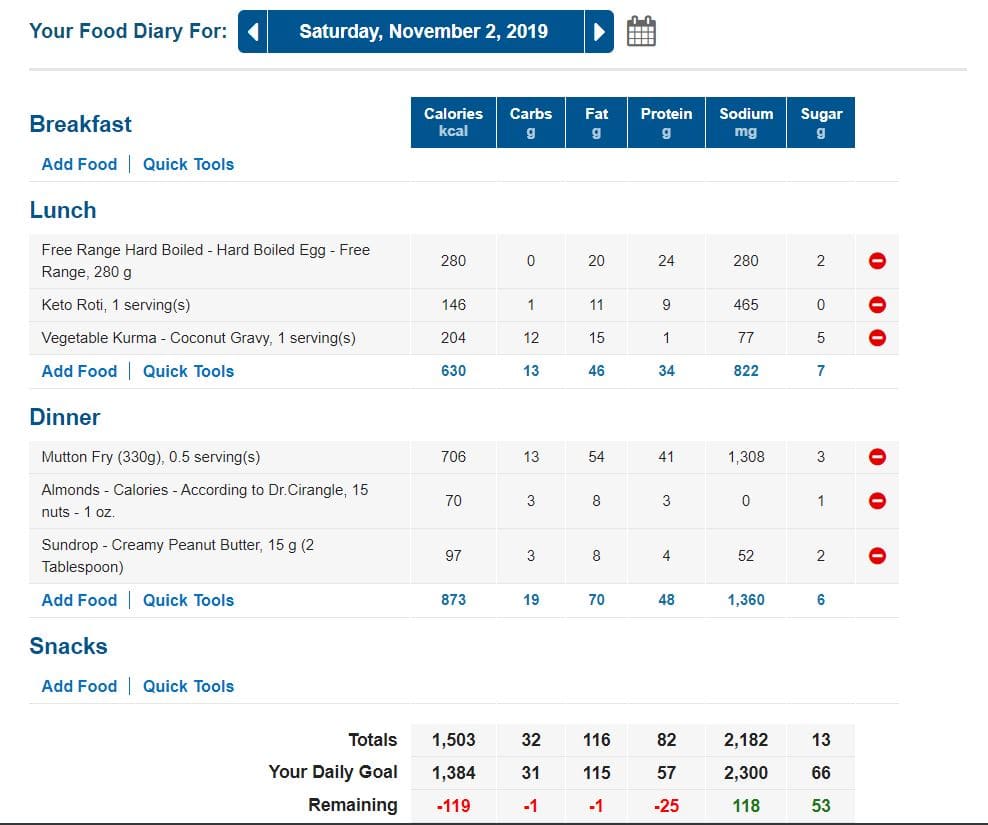
The advantage of strict keto is that as the macros are accurately tracked, ketosis is guaranteed. When I followed keto for 4 months, I accurately tracked my macros for about 2 months. Below is a sample day of entry in the MyFitnessPal app.
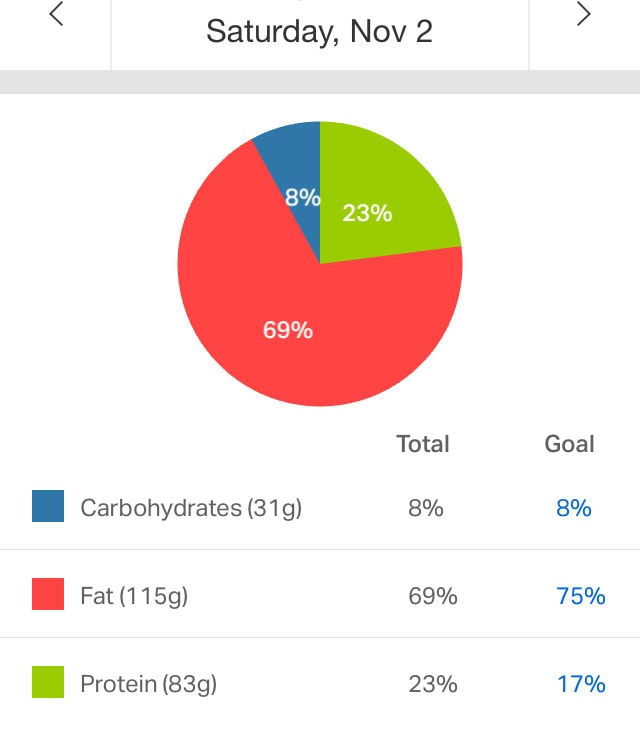
And below is the macro nutrient chart for the above entry.

The disadvantage of strict keto is the hassle of tracking all the meals. Many times, lots of Indian dishes are not available in the database of these apps. I had to create my own recipes with accurate quantity of main ingredients used in the dishes I ate.
Because of this many people do not prefer the strict keto method. For them Lazy Keto is to the rescue. After the first 2 months of strict keto, I had switched to 2 months of lazy keto.
Lazy Keto:
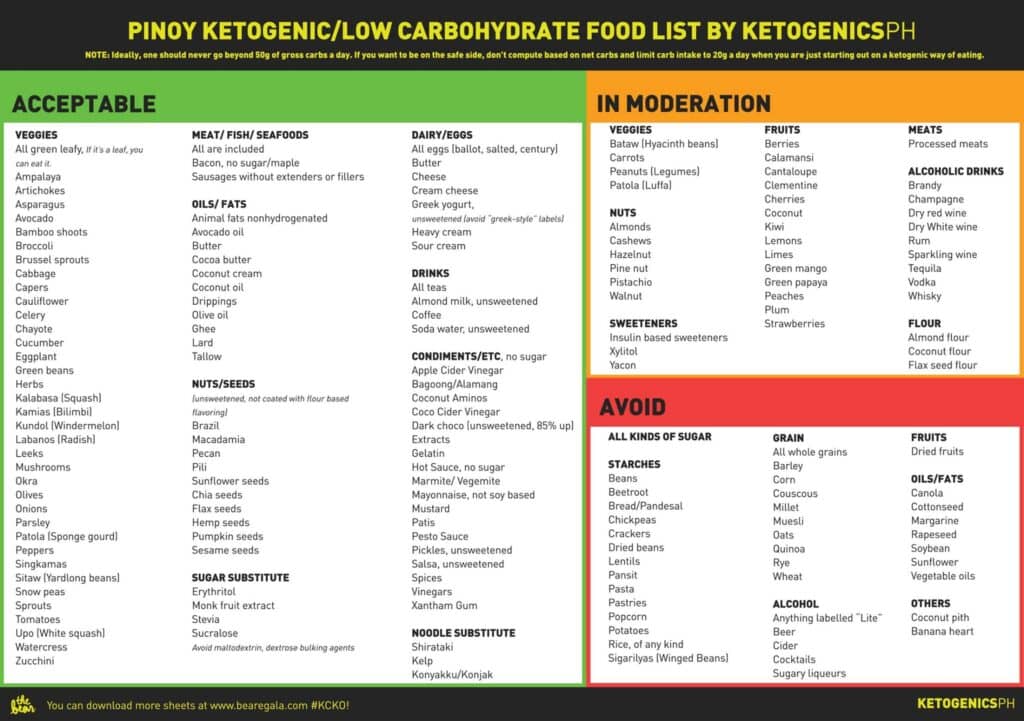
In lazy keto one needs to follow a basic list of food groups – food that can be consumed liberally, food that must be consumed in moderation and food that must be avoided. Below is an example of such a food chart.
Another very useful article about low carb food groups is from the website dietdoctor.com.
https://www.dietdoctor.com/low-carb/foods
This article groups food into various categories like vegetables, fruits, nuts, meats etc., and provides information on net carb content of various foods in each group. I am attaching a few sample images from this article below. Visit this article for complete list and more details.

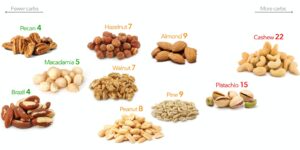

Image source: https://www.dietdoctor.com/low-carb/foods
The advantage of lazy keto is that it can be followed easily by anyone without need for an expert nutritionist to design the diet. The disadvantage is that it is possible to get carried away with the “in moderation” food groups which can drive the net carbs above the target and result in getting kicked out of Ketosis.
Common doubts, misconceptions and mistakes in Keto
Below is a compilation of common doubts, mistakes and misconceptions of Keto diet.
Replacing carbs with protein:
This is a very common misconception and mistake many make in Keto. They replace the carbs with protein. This is wrong. In Keto, protein has to still remain the same (0.5g to 1.5g per kilo of lean body mass). Carbs must be replaced with fat.
How often can I include a cheat meal?
In Keto, the body is put in a metabolic state called Ketosis. It takes anywhere between 4 days to even 2 weeks to get into Ketosis. But one cheat meal can kick you out of Ketosis and it would take the same number of days to get back into Keto. Of course, as your body gets used to Keto, it becomes metabolically flexible and can switch over to Ketosis sooner than it did when you did Keto the first time. Even when the body has become metabolically flexible, it takes 3 to 4 days to get back into ketosis. Because of this cheat days have to be kept very rare – maybe once in 4 to 6 weeks.
I get head aches and mood swings when I start Keto. Why is this?
This is something called Keto flu and is very common when one begins Keto. This is your body resisting the change from using glucose as primary fuel to fat as primary fuel. It takes just a few days of persistence to get out of these symptoms. Once the body transitions to ketosis, all these symptoms will go away, and you will feel much more energetic.
The daily carb limit is 20 grams. Can I have a 200ml can of Coco-Cola which has about 20 grams carbohydrates?
Absolutely not! The 20 grams of carbs is to be consumed spread over the day. That is how the insulin level will stay low. Body will be in ketosis only when insulin level is very low. A 200ml can of coke will pump in 20 grams of carbs which will result in an insulin spike. This will signal the body that it can switch to glucose as energy source and the body will come out of Ketosis. The 20 grams of carbs should come mostly from vegetables. For those sweet cravings, you could have a small piece of dark chocolate (85% or more).
Due to the very low carbs, wouldn\’t I suffer from hypoglycemia (low blood sugar levels)?
In the absence of carbs, liver can synthesize glucose from fat and protein by a process called gluconeogenesis. Blood sugar levels are maintained by this process. However, if you are a diabetic under medication, the dosage of medicines will have to be properly adjusted to avoid hypoglycemia.
Micro-nutrients and supplements
As the muscle glycogen is completed depleted in Keto, the water molecules that are held by the glycogen are also flushed out by the kidneys. This results in electrolytes like magnesium, sodium and potassium getting flushed out by the body which can lead to symptoms like muscle cramps, constipation, reduced sleep etc.
This can be addressed in two ways.
Include multiple categories of food groups which are rich in micro-nutrients and minerals. Below article provides a good summary of food groups in Keto that provide various micro-nutrients
https://compoundsolutions.com/micronutrients-in-the-ketogenic-diet/
Add micro-nutrient supplements like magnesium citrate, potassium citrate, more salt in the diet to supplement sodium, multi-vitamin tablets etc.
This is an important part of formulating a good Keto diet. Ignoring micro-nutrients can result in undesirable side effects.
Is doing Keto safe?
This is a very common doubt everyone has on Keto. We still do not have any conclusive study that proves Keto is safe in the long-term. But in my opinion, I feel human body has evolved in a million years to burn both fat and glucose as fuel sources. As fat is a much cleaner fuel, it should have evolved to use fat as the primary source of fuel and glucose as secondary source for those high intense needs from muscles. So, Keto should be safe in the long run provided micro-nutrient requirements are properly taken care of.
Sustainability of Keto diet over long time
There are a few factors that affect the sustainability of Keto diet over long time.
Societal pressure: From the perspective of Indian diet, there are many challenges in following Keto in a society that eats a carb rich diet. When you attend a social gathering with is no option for Keto, it is going to be very difficult to explain to others why you are sipping on that salted lime juice or black coffee. You become a social pariah and people start giving you that “is this guy crazy?” look!
Cooking two meals at home: When everyone in the family is following the regular carb rich diet, it becomes necessary to cook two different meals – Keto for you and regular meals for others. This results in extra effort for the family and over long term, there is bound to be resistance to this diet.
Vegetarians: For vegetarians, Keto can become quite boring, as the options for fat and protein are very limited. This becomes much more challenging when egg is also ruled out of the diet.
Micro-nutrient deficiency and side effects: As micro-nutrient supplementing is very important to avoid side effects like constipation, cramps, lack of sleep etc., this can become a little stressful in the long run to manage the diet.
Despite all the above factors, I know many who have been sustaining Keto over long term.
Conclusion:
Keto is a very effective tool that can be used depending on a person’s state of health and goals.
For those who want to live a healthy life with all the health benefits that Keto offers and can sustain Keto over long term, Keto can become a lifestyle.
For those who want to achieve quick results in weight loss, but cannot sustain Keto for long term, it can be used for a short term like 3 to 6 months, and once the goal is reached, they can switch to maintenance mode with IF and moderate carbs and physical activity.
For those with health conditions like Type-2 diabetes, Keto can be used effectively to reverse the situation and once reversed, they can go back to a lifestyle with IF and moderate carbs to maintain.
Discover more from graaja.blog
Subscribe to get the latest posts sent to your email.

2 Comments