Reversing Diabetes with Intermittent Fasting and Low Carb Diet
I have mentioned in my previous blog posts about reversing diabetes using intermittent fasting and low carb diet. In this article, I will explain some details on how this can be done.
Important Notes:
- This article is to provide information on how IF and low carb can be used to reverse diabetes and should not be considered as a medical advice. If you are under medication for diabetes, discuss with your doctor and do it under his supervision as the dosage of medicines will have to be adjusted as required.
- This article applies only to Type-2 Diabetes. The concept does not apply to Type-1 Diabetes.
Is type-2 diabetes reversible?
One of the most common misconceptions is that type-2 diabetes is not curable and that it can only be managed with lifelong medication and some lifestyle and diet changes. This is wrong. If one understands the root cause of Type-2 diabetes and addresses this root cause, Type-2 diabetes is reversible, and one can be cured and stay off medication for life. So, what is this root cause and how can this be addressed? To understand this, let us first understand how Type-2 diabetes develops.
The anatomy of type-2 diabetes
The first step in understanding Type-2 diabetes is to understand the role of Insulin. Insulin is a hormone secreted by pancreas and is responsible in regulating the glucose levels in blood.
When we eat, the carbohydrates in our food are converted into glucose and enter the blood. When body senses this increase in glucose, it instructs the pancreas to secrete insulin. This insulin tells all the cells in our body to use the available glucose for energy. The cells then take this glucose and convert it to energy. As the glucose in blood gets depleted, the body signals the pancreas to wind down the insulin production and insulin level in the blood also drops.
This is a wonderful feedback mechanism in our body and can be compared to cruise control in automobiles. When you set your car to cruise at a speed, the electronic brain in the car adjusts the fuel to maintain speed. When the car is climbing a slope (glucose level rises), the controller increases the fuel input (pancreas steps up insulin production) to the engine and when the car is on level ground or downward slope (glucose level falls), it reduces or cuts off fuel (pancreas steps down insulin production) to the engine.
Everything works well till we start developing something called Insulin Resistance. In our current lifestyle of carb loaded food (rice, pasta, bread, soft drinks, pastries, cakes…), frequent eating (breakfast, pre-lunch snack, lunch, post lunch snack, dinner), and sedentary lifestyle, our body is constantly exposed to high levels of insulin. As cells are exposed to constant insulin, they start developing a resistance to insulin. Because of this, they do not take in glucose for energy. This results in elevated glucose levels and the body signals the pancreas to generate more insulin. The cells respond to this increase in insulin, but after some time, develop more resistance. This results in a chain reaction and at some point, the pancreas maxes out its capacity and a person are diagnosed with pre-diabetes or diabetes.
Diabetes or pre-diabetes are usually detected through blood test for fasting glucose level or hbA1c. Fasting glucose above 100mg/dL (100 – 125) is considered pre-diabetic and >125 as diabetic. hbA1c above 5.6% (5.7% to 6.4%) is considered pre-diabetic and above 6.5% as diabetic. However, these tests reveal the pre-diabetic or diabetic condition only when the condition occurs. By the time it is termed pre-diabetes or diabetes it is already an advance state of insulin resistance and needs medication to keep it under control.
Diabetes is not a disease that develops overnight, but over a couple of decades. This can be detected only by measuring fasting insulin levels. For example, below is a representation of how fasting insulin level and fasting glucose level vary over a couple of decades in an adult.
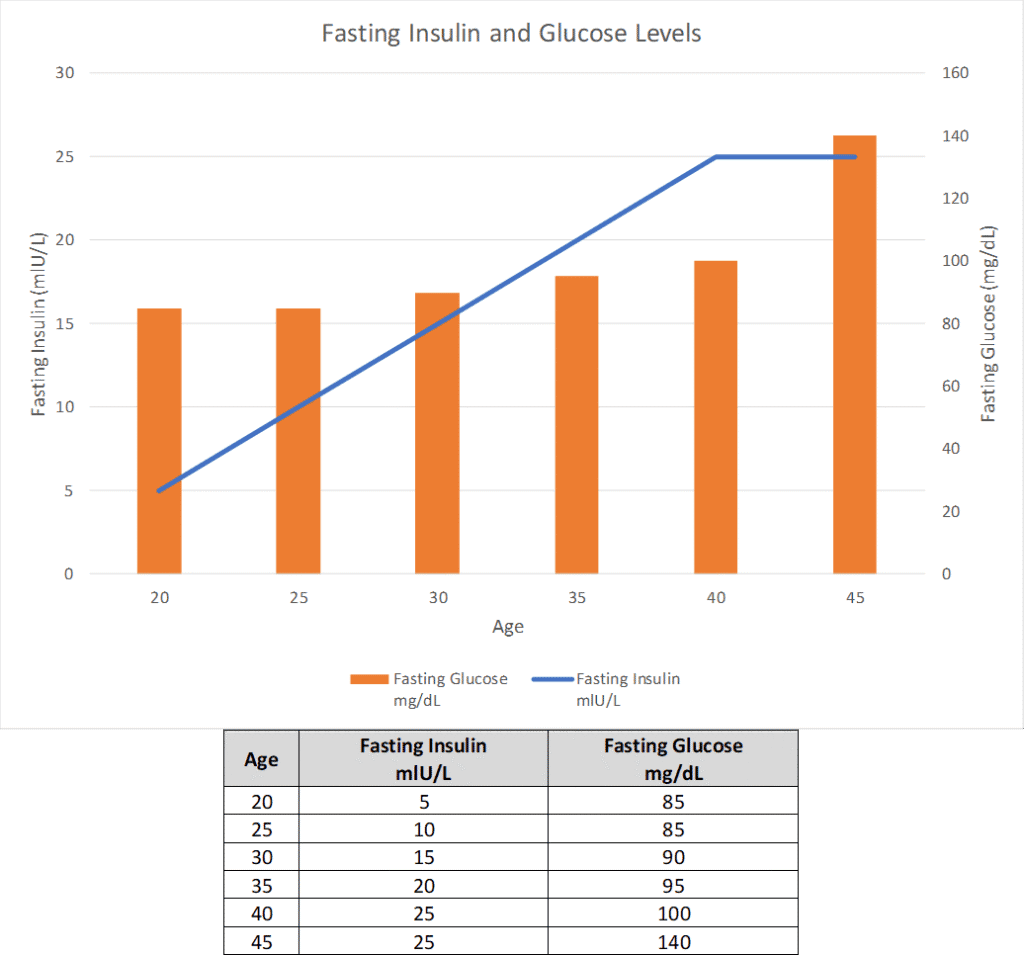
In 20’s when insulin resistance is very low, a small amount of insulin is sufficient to keep the glucose levels down. But as we age and develop insulin resistance, the amount of insulin it takes to keep blood glucose regulated keeps increasing. For example, we may need 2x or 3x the insulin in our 30’s compared to our 20’s. By the time we hit 40’s we may develop high enough insulin resistance that the insulin from pancreas is not enough to keep blood glucose under control and fasting glucose shoots up. In the graph above, the blue line becoming flat indicates pancreas not able to keep up with the demand. This is when we are diagnosed with pre-diabetes or diabetes.
Insulin resistance also leads to metabolic syndrome which in turn can lead to obesity, cardiovascular diseases etc.
So, the root cause of type-2 diabetes is insulin resistance which is caused by carb rich food, frequent meals and sedentary lifestyle.
Note: The numbers shown in the graph above are just a visual representation to explain how type-2 diabetes develops over time. The actual numbers and how quickly one develops insulin resistance can vary from person to person based on their genetic code, lifestyle and diet.
Reversing diabetes – addressing the root cause:
The current medical system mostly manages diabetes with insulin or other drugs. These do not address the insulin resistance but increase the insulin level in blood to help regulate glucose. This further increases the insulin resistance. This is a lifelong process where the dosage of drugs keeps increasing.
The correct approach would be to address the root cause and reverse the insulin resistance. How do we do this? The answer is simple. Keep the body free of insulin most of the time. When body is free of insulin, cells start forgetting about insulin and the insulin resistance starts reducing.
How do we keep the body free of insulin? There are a couple of methods – Intermittent Fasting and Low Carb eating. With low carb diet, we cut carbohydrates in our food which reduces the blood glucose levels and in turn reduces insulin. With intermittent fasting, we increase our fasting window (time when we do not eat anything), which increases the time the body is free of insulin. A combination of both these approaches is guaranteed to reverse insulin resistance and cure type-2 diabetes.
I have written about intermittent fasting and low carb diet in my previous articles. Links below:
LCHF and Keto 101 – A Beginners Guide to Low Carb Eating Part 1
LCHF and Keto 101 – A Beginners Guide to Low Carb Eating Part 2
Intermittent Fasting, LCHF and Keto can be used in combination depending on the severity of the symptoms. If someone is pre-diabetic and has not yet started any medication, they may be benefitted by a combination of intermittent fasting and a moderate carb diet. If someone is already diabetic and is under medication, they may need intermittent fasting with low carb or Keto diet to reverse the insulin resistance. Once the insulin resistance is reversed, they can switch over to intermittent fasting and moderate carb diet as a lifestyle to stay healthy for life.
The role of physical activity:
Though diabetes can be reversed mainly by dietary changes, physical activity also helps a lot in this process. When one performs moderate to vigorous physical activities, the cells use more glucose for energy and this can result in insulin levels dropping sooner. This is one of the reasons why physical activity is recommended in the conventional system of diabetes management as well.
So, it is recommended to add 30 minutes to 60 minutes of moderate (brisk walking, jogging, cycling or swimming) to intense physical activity (strength training, HIIT) at least 5 days a week for faster results.
Very important note:
If someone is a diabetic and is under medication, they may have to either not take medication during fasting window, or reduce the dosage depending on the fasting glucose levels. If care is not taken, it may result in hypoglycemia (very low blood glucose). Also, as the insulin resistance is reversed, the dosage of medicines will have to be gradually reduced. So, if you are a diabetic under medication, please consult your doctor and take his support. There are many doctors who are now open to the idea of using IF and low carb diet as a treatment approach to diabetes.
Conclusion:
Contrary to the general belief that diabetes is going to last a lifetime and has to be managed with lifelong medication, it is possible to reverse diabetes and stay off medication and lead a healthy life by following intermittent fasting and low/moderate carb diet as a lifestyle. Many doctors are also opening up to the idea of using IF and low carb / Keto as treatment methods to reverse diabetes. I hope this becomes part of standard treatment protocol for diabetes in the coming years.
Discover more from graaja.blog
Subscribe to get the latest posts sent to your email.